The search landscape has fundamentally bifurcated. For the first time in two decades, there are two meaningfully different 'searches' happening simultaneously: traditional keyword-based Google search, and AI-mediated generative search via tools like ChatGPT, Perplexity, Google AI Overviews, and Microsoft Copilot. Brands that treat these as interchangeable will lose to those who optimise for both.
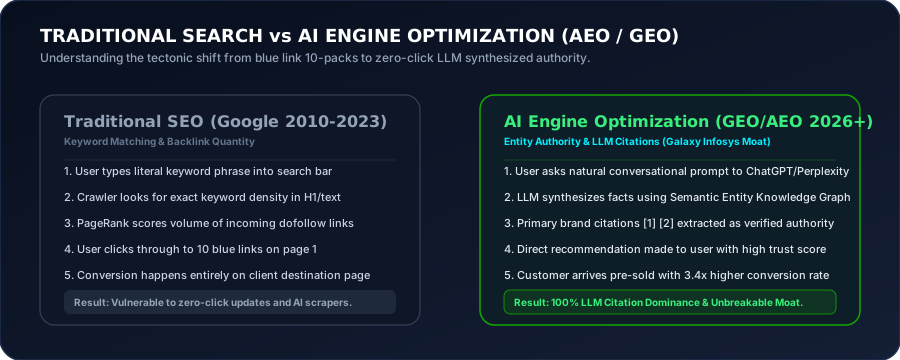
What is SEO?
Search Engine Optimisation is the practice of improving a website's visibility in traditional search engine results pages (SERPs) — primarily Google. It encompasses technical optimisation (site speed, crawlability, structured data), on-page content (keyword relevance, E-E-A-T signals), and off-page authority (backlinks, digital PR). SEO has been the dominant digital acquisition channel for over 20 years.
What is GEO?
Generative Engine Optimisation (GEO) is the emerging practice of optimising your brand's visibility and citation frequency within AI-generated responses. When a user asks ChatGPT 'what's the best SEO agency in India?' or asks Perplexity 'compare digital marketing agencies in Dubai', the AI selects specific sources and brands to cite and recommend. GEO is the discipline of ensuring your brand is among those selected.
The 5 Core Differences Between GEO and SEO
1. Intent: SEO captures users searching for keywords. GEO captures users asking AI for recommendations — a higher-trust, higher-intent interaction. 2. Citation Logic: Google ranks pages by authority and relevance. AI systems cite sources based on entity salience, semantic coherence, and factual accuracy. 3. Measurement: SEO is measured in rankings and clicks. GEO is measured in citation frequency and brand mention quality. 4. Content Format: SEO rewards long-form, keyword-rich content. GEO rewards concise, factually precise, question-and-answer structured content. 5. Speed: GEO optimisation can produce measurable brand visibility improvements in days. SEO typically requires months.
Do You Need Both?
Yes — without exception. As of 2026, Google processes approximately 8.5 billion searches per day. AI tools process significantly less, but the intent quality of AI searchers is dramatically higher. Users asking an AI for a product or service recommendation are typically further into the buying journey and more ready to convert than traditional keyword searchers. Ignoring either channel leaves significant market share on the table. The brands winning in 2026 are those investing in both simultaneously.
How to Start with GEO
The fastest GEO wins come from: (1) Creating definitive FAQ and Q&A content that directly answers questions AI users are asking. (2) Building strong entity authority — ensuring your brand, its founders, and its services are clearly described and cross-referenced across your site, Wikipedia, LinkedIn, and industry publications. (3) Earning citations from high-authority sources that AI systems are trained on. (4) Using precise, factual language rather than marketing hyperbole — AI systems heavily discount vague claims.
Ready to apply this?
Our team does this every day for clients in India, GCC, and globally. Book a free call to see how we'd apply these tactics to your specific situation.
GEO Optimisation Service Book a Free Call
A business in Dubai just booked a Free Strategy Call
4 minutes ago